
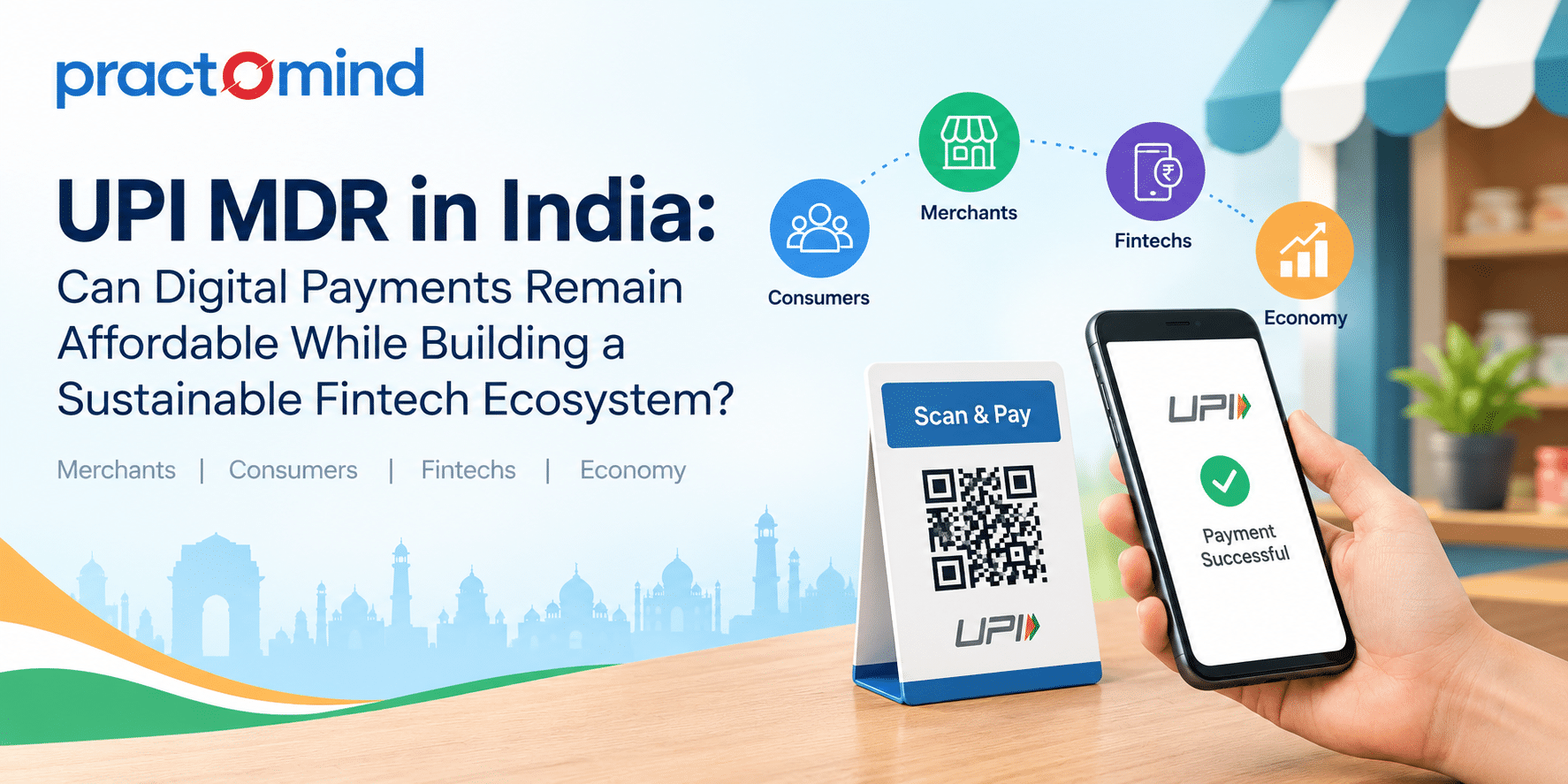
India’s Unified Payments Interface (UPI) has fundamentally transformed the way the country pays, collects and does business. From roadside tea stalls and neighborhood kirana stores to large enterprises, online marketplaces and financial institutions, UPI has made real-time digital payments accessible to millions of people. Its success has been built on a powerful proposition: simple, instant, interoperable payments without a transaction fee for ordinary bank-account-based UPI payments.
But as India’s digital payment ecosystem continues to expand, an important question has emerged: Who should pay for the infrastructure, technology, security and innovation required to sustain this ecosystem?
However, this question lies at the heart of the debate around the Merchant Discount Rate (MDR) on UPI. In 2026, India moved towards introducing a limited MDR framework for selected higher-value merchant transactions. The proposed rollout, originally scheduled for 15 October 2026, was postponed until after Diwali, with the revised implementation date yet to be confirmed as of 16 October 2026. The development marks a potentially important shift in the economics of digital payments. However, it is not a proposal to charge every UPI user or impose a blanket fee on all transactions. For merchants, fintech companies, banks, payment service providers and consumers, the real question is how India can balance affordability, innovation, financial inclusion and commercial sustainability.
At PractoMind, we believe this discussion deserves to go beyond the question of whether UPI should be free or paid. It should focus on building a resilient financial ecosystem that creates value for every participant.
1. What is MDR, and why does it matter?
Merchant Discount Rate is the fee associated with processing a digital payment accepted by a merchant. Depending on the payment arrangement, it is distributed among participating entities such as acquiring banks, payment processors and other service providers. MDR is not the same as a tax. It is also not necessarily a fee collected by the government. In a conventional card-payment transaction, the merchant may pay a percentage of the transaction value to accept a card payment. That revenue helps support the payment infrastructure and participating businesses.
However, UPI formed under a different commercial model. India prioritized widespread adoption of interoperable digital payments, with zero MDR on ordinary bank-account-based UPI payments becoming an important part of the model. This encouraged merchants to accept QR-based payments and enabled consumers to move away from cash without worrying about transaction charges. The resulting scale has been remarkable. However, a payment being free to the user does not mean the underlying infrastructure is free to operate.
Payment companies and financial institutions still need to invest in:
- Technology infrastructure, servers and payment processing.
- Fraud detection, cybersecurity and risk management.
- Merchant onboarding, verification and technical support.
- Transaction reconciliation, dispute resolution and settlement operations.
- QR-code distribution, merchant education and acceptance infrastructure.
- Product development, system upgrades and regulatory compliance.
The fundamental economic challenge is that payment infrastructure incurs costs even when individual transactions generate little or no direct revenue. The MDR debate is therefore about finding a sustainable way to finance a public-facing digital payment ecosystem without undermining the affordability that made it successful.
2. What is the proposed MDR framework in India?
The Government of India and NPCI have outlined a framework that applies charges to selected person-to-merchant (P2M) transactions while protecting ordinary consumers and a large proportion of merchant payments. The proposed framework announced in September 2026 includes the following provisions.
| Transaction category | Proposed treatment |
|---|---|
| Person-to-person (P2P) UPI payments | Remain free, irrespective of transaction amount |
| Merchant payments up to ₹2,000 | Zero MDR |
| Eligible small merchants under the P2PM category | Zero MDR under the applicable eligibility conditions |
| Selected merchant transactions above ₹2,000 | MDR of 0.4% |
| Transactions of ₹75,000 and above under the general rate | MDR capped at ₹300 per transaction |
| Selected essential-sector transactions above ₹2,000 | Flat ₹5 MDR |
| Eligible capital-market transactions | 0.02% MDR, capped at ₹300 |
The framework identifies sectors such as railways, telecommunications, insurance, fuel and agricultural inputs for special treatment. The exact classification of a transaction and its applicable rate must be determined under the official rules. The small-merchant protection includes eligible merchants receiving up to ₹1 lakh per month through UPI QR codes under the P2PM category. This is a category-specific condition, not an automatic exemption for every business with low turnover. The government has also stated that 96% of merchant transactions are expected to remain unaffected and that customers must not be charged MDR directly. A dedicated fund equivalent to 5% of total MDR collections has been proposed to support small-merchant UPI acceptance.
Important implementation update: NPCI postponed the scheduled 15 October 2026 rollout until after Diwali. The framework described here reflects the announced policy, not confirmation that the revised charges are already being applied to transactions on 16 October 2026.
Official references:
- Ministry of Finance: UPI MDR framework and clarifications
- Department of Financial Services: MDR FAQs
- Reuters: India postpones UPI payment fee rollout until after Diwali
3. How much could MDR cost a merchant?
To understand the calculation, lets start with an example. Consider a merchant who accepts a UPI payment of ₹10,000 under the proposed general rate. At an MDR of 0.4%, the calculation would be:
₹10,000 × 0.4% = ₹40
The table below illustrates the proposed general rate, before considering any applicable special-sector classification.
| Payment amount | Illustrative MDR at 0.4% |
|---|---|
| ₹500 | ₹0 under the proposed threshold |
| ₹2,000 | ₹0 under the proposed threshold |
| ₹5,000 | ₹20 |
| ₹10,000 | ₹40 |
| ₹25,000 | ₹100 |
| ₹50,000 | ₹200 |
| ₹75,000 | ₹300 |
| ₹1,00,000 | ₹300, after the proposed cap |
These examples assume that the transaction falls within the general MDR category and that the announced threshold and cap apply as described. For a merchant accepting ₹10 lakh per month in eligible transactions above ₹2,000, an illustrative 0.4% fee on the entire ₹10 lakh would equal ₹4,000. Actual charges would depend on the transaction mix, the value of individual payments, exemptions, applicable caps and final implementation rules.
The direct percentage may appear small, but its impact depends on the business’s profitability. For a business operating on a 3% net margin, a payment-processing cost equivalent to 0.4% of eligible transaction value can consume a meaningful portion of the margin attributable to those sales. For a business with a 20% margin, the same charge may be much easier to absorb. This is why MDR should not be evaluated only in percentage terms. It must also be assessed against merchant profitability, transaction frequency and the cost of alternative payment methods.
4. Why are fintech companies and payment providers supporting MDR?
For many payment companies, the MDR debate concerns the economics of maintaining and expanding the payment ecosystem. A payment transaction involves more than transferring money between two bank accounts. Behind the user experience are banks, payment applications, payment service providers, technology platforms, risk systems and operational teams. When transaction volumes grow but direct payment revenue remains limited, providers must find other sources of income or depend on external support. Industry discussions have highlighted the need for a revenue model that encourages continued investment without requiring complete recovery of all operating costs through transaction fees.
There are several reasons why a limited MDR framework may help.
Sustainable payment infrastructure: Payments infrastructure requires continuous investment in reliability, processing capacity, cybersecurity and resilience. A predictable revenue stream can help participating organisations fund these investments and reduce dependence on temporary incentives or uncertain funding arrangements.
Better merchant services: Merchant payments are becoming more sophisticated. Businesses increasingly expect integrated collections, automated reconciliation, settlement visibility, refunds, reporting and dispute management. Revenue from payment services can help fund the development and maintenance of these capabilities.
More sustainable fintech business models: Fintech companies often compete aggressively to acquire merchants, distribute QR codes and build payment volumes. However, customer acquisition and servicing have real costs. A commercially viable payment business is better positioned to invest in product quality, customer support and new services over the long term.
Greater incentives to serve underserved markets: Smaller towns and rural markets may require additional investment in merchant education, onboarding, support and acceptance infrastructure. If the ecosystem has a reliable way to finance these activities, providers may have stronger incentives to expand beyond the most commercially attractive urban markets.
However, these benefits are not automatic. They depend on how MDR revenue is distributed, whether it reaches the organisations incurring the costs and whether competition encourages providers to reinvest in better services.
5. What are merchants saying? The concerns cannot be ignored
While fintech companies may welcome a more sustainable revenue model, merchant acceptance is far from guaranteed. Retail associations have raised concerns about the additional burden on businesses, especially those that operate on thin margins or process a high volume of relatively large payments. The most important concerns are outlined below.
Small businesses may still feel the pressure: The proposed small-merchant exemption is a positive safeguard. However, eligibility depends on the applicable merchant category and collection threshold. Some businesses that regard themselves as small enterprises may not qualify for the exemption, even if their profitability is limited. A ₹1 lakh monthly UPI collection threshold may also be restrictive for some businesses with substantial digital sales but limited margins. Policy design should consider the economic characteristics of merchants, rather than relying exclusively on a single collection threshold.
Businesses may reconsider their payment preferences: If merchants believe that digital payments are becoming more expensive, some may encourage customers to use cash or another payment method. This is particularly relevant where margins are low, cash handling is already established or customers have limited alternative payment options. The extent of any shift remains uncertain. It will depend on merchant awareness, enforcement, competing payment methods and the actual cost of MDR.
Transaction splitting could become a concern: If a fee applies above a transaction threshold, merchants and customers may be tempted to divide a large payment into smaller transactions. For example, a payment of ₹6,000 might be divided into three payments of ₹2,000 if users believe that doing so avoids MDR. Such behaviour can create reconciliation problems, complicate refunds and increase transaction-processing activity. It may also undermine the intended policy. Clear communication, appropriate transaction monitoring and proportionate controls will also be important.
Essential sectors require careful treatment: Fuel retailers, transport providers, agricultural businesses and other essential services may operate with limited margins or face specific commercial constraints. The proposed flat-fee treatment for selected essential sectors recognises some of these concerns. Nevertheless, accurate classification, transparent billing and predictable implementation remain essential. The objective should be to prevent a payment fee from becoming a disproportionate burden on sectors that serve large sections of the population.
6. What are consumers concerned about?
The government’s stated framework protects consumers from direct MDR charges. Nevertheless, the distinction between a direct fee and an indirect economic cost is important. Consumers may experience the effects of MDR in several ways.
A. Will UPI stop being free?
This is the most immediate concern. For everyday users, UPI is not merely a payment product; it has become part of routine economic life. Consumers use it to pay for groceries, transportation, food, utilities and countless other purchases. Clear communication must distinguish between person-to-person payments, merchant payments below the threshold and the selected merchant transactions covered by MDR. The proposed framework does not introduce a universal fee for every UPI transaction.
B. Could merchants increase prices?
The government has stated that MDR should not be passed on directly to customers and that merchants should not impose hidden charges. Even so, businesses may consider their overall operating costs when setting prices. If payment-processing costs rise, some businesses may attempt to recover those costs through their general pricing structure. This is a potential indirect economic effect, not proof that consumer prices will necessarily increase. Monitoring merchant practices and enforcing applicable consumer protections will be important.
C. Could consumers return to cash?
If customers believe that merchants prefer cash or that digital payments have become inconvenient, some may change their behaviour. This could affect transaction transparency, convenience and the formal record of everyday economic activity. However, consumers also value the speed, safety, convenience and record-keeping benefits of digital payments. These advantages may help sustain adoption even when payment economics change.
D. Will the rules create confusion?
Different rates, thresholds, exemptions and merchant categories can make the framework difficult to understand. Consumers should not be expected to understand the commercial arrangements between banks and payment providers every time they scan a QR code. The experience should remain simple, with clear receipts, transparent merchant practices and accessible channels for complaints.
7. What could MDR mean for the broader Indian economy?
The impact extends beyond payment companies and merchant fees. UPI has become an important part of India’s digital economic infrastructure, influencing commerce, financial inclusion and business formalization.
A. Digital financial inclusion
UPI has reduced barriers to digital transactions for individuals and businesses that previously relied heavily on cash. The long-term challenge is to preserve that accessibility while maintaining the infrastructure required to support it. If MDR revenue is used effectively to expand acceptance, strengthen reliability and improve rural connectivity, it could support the next stage of financial inclusion. If the framework creates confusion or disproportionately affects smaller merchants, it could weaken some of those gains. The outcome will depend on implementation.
B. Business formalization and transaction records
Digital payments create electronic records that can support bookkeeping, reconciliation and business visibility. For small businesses, these records can make it easier to understand cash flow, manage collections and demonstrate business activity to financial institutions. A sustainable UPI ecosystem can support these benefits. Conversely, a significant return to cash in affected segments could reduce some of the transparency gains associated with digital transactions.
C. Credit access for MSMEs
Reliable digital transaction histories can help businesses build more complete records of their operations. When combined with consent-based financial information and appropriate underwriting, these records may support better credit assessment and working-capital products. MDR does not automatically improve access to credit. Its contribution would be indirect, through the sustainability of digital payment acceptance and the availability of reliable transaction data.
D. Productivity and economic efficiency
Digital payments can reduce the time spent handling cash, reconciling accounts and managing physical collections. Payment infrastructure also creates costs, including technology, fraud prevention and operational support. A well-designed commercial model must balance these costs against the productivity benefits that digital payments deliver to businesses and consumers.
E. Competition and innovation
A predictable revenue framework could encourage providers to invest in payment products, merchant services and financial technology. However, there is also a competition risk. If smaller providers cannot secure sufficient revenue or negotiate sustainable commercial arrangements, the market could become more concentrated. The policy should therefore encourage transparent revenue sharing, interoperability and fair competition instead of merely generating additional revenue for the largest participants.
8. How will MDR impact fintech companies?
The impact will differ significantly depending on a company’s role in the ecosystem.
| Fintech segment | Potential opportunity | Key risk |
|---|---|---|
| UPI application providers | Greater opportunity to monetise eligible merchant payment activity | High competition and uncertain revenue per transaction |
| Payment aggregators and processors | Improved economics for eligible payment-processing services | Integration costs, compliance and merchant resistance |
| Banks and payment service providers | Additional revenue to support payment operations | Continued infrastructure, fraud and servicing costs |
| Merchant technology platforms | Demand for better reconciliation, reporting and payment-cost management | Increased merchant price sensitivity |
| Embedded finance and API providers | Opportunities to integrate payments with business workflows | Dependence on third-party payment infrastructure |
| Rural fintech and merchant networks | Potential investment in wider digital acceptance | Thin merchant margins and higher servicing costs |
The most important point is that MDR revenue is not the same as net profit.
Payment providers must still account for operating costs, partner revenue shares, technology expenditure, compliance and customer acquisition. The commercial outcome will depend on the final implementation rules and the distribution of revenue across participating entities. For smaller fintech companies, MDR could create an opportunity to build sustainable businesses around payments. However, success will depend on efficient operations, merchant relationships, differentiation and the ability to provide value beyond basic transaction processing.
9. What does this mean for PractoMind and the future of fintech?
For PractoMind, the MDR debate is particularly relevant to the broader development of a full-stack fintech ecosystem. Payment infrastructure is only one component of a sustainable financial services business. Long-term value can also be created through merchant onboarding, transaction banking, payment APIs, reconciliation, fraud risk management and integrated business services. A more commercially sustainable payment ecosystem could create opportunities in several areas.
Integrated merchant payment solutions: Businesses increasingly need more than a QR code. They need a connected system that helps them collect payments, track transactions, reconcile settlements and manage exceptions. Fintech platforms can differentiate themselves by integrating payment acceptance with accounting, CRM, reporting and operational workflows.
API-led payment infrastructure: Businesses and financial institutions need reliable APIs for collections, transaction reporting, payment status updates and reconciliation. A sustainable commercial model may support continued investment in these capabilities, provided that the value delivered to customers remains clear.
Fraud risk management and transaction monitoring: As digital payments scale, fraud prevention and operational resilience become increasingly important. Fintech providers can invest in monitoring, anomaly detection, merchant verification, transaction controls and dispute-management workflows. These capabilities are critical to trust and can create commercial value beyond the payment transaction itself.
Merchant onboarding and distribution: There remains an opportunity to help businesses adopt digital payment systems with better onboarding, training, support and integrated tools. The challenge is to build a model in which merchant acquisition and servicing are commercially sustainable without making participation unnecessarily expensive for smaller businesses.
Diversified fintech revenue: A resilient fintech business should not depend entirely on one transaction fee or a single regulatory framework. Depending on its authorisations, partnerships and commercial model, a provider can explore value-added services such as reconciliation software, merchant management tools, API services, reporting, fraud prevention and business automation.
The principle is straightforward: build products that customers are willing to pay for because they solve meaningful problems, rather than depending solely on payment volume.
10. What should India get right before MDR implementation?
Introducing MDR is only one part of the policy challenge. The framework must also be understandable, enforceable and commercially workable. We believe six priorities deserve particular attention.
1. Protect everyday digital payments. Person-to-person transactions and the specified exempt merchant categories should remain protected as announced, with clear communication about eligibility and scope.
2. Keep merchant charges transparent. Merchants should know which transactions qualify, what rate applies and how the fee is calculated. Clear settlement statements should make reconciliation straightforward.
3. Prevent hidden consumer charges. Applicable rules prohibiting direct pass-throughs and hidden fees should be communicated and enforced consistently.
4. Review small-merchant eligibility. The threshold and merchant classification rules should reflect actual business conditions. Evidence from microenterprises, retailers and regional markets should inform future reviews.
5. Ensure fair distribution of revenue. The participants bearing infrastructure and operational costs should receive commercially meaningful compensation. Revenue-sharing arrangements should support competition and service quality.
6. Measure outcomes, not just collections. Policymakers should monitor merchant acceptance, transaction growth, payment failures, fraud, consumer complaints and the adoption of digital payments in underserved regions.
These indicators can help determine whether MDR is supporting the intended objectives or creating unintended consequences that require adjustment.
11. What should fintech companies and merchants do now?
While the revised implementation date remains pending, businesses can prepare without assuming that the proposed framework is already operational. Merchants should review their payment mix, average transaction value, monthly collections and operating margins. They should also confirm their merchant classification and seek written clarification from their acquiring bank or payment service provider about applicable rates and exemptions.
Fintech companies should review their pricing, settlement processes, merchant communication, transaction classification and technical readiness. Technology providers can help by building reporting tools that estimate payment costs, flag eligible transactions and reconcile settlement deductions. Businesses should avoid changing payment policies or imposing additional customer charges based on speculation. They should rely on confirmed implementation instructions and the terms applicable to their own payment arrangements.
For fintech founders, this is also an opportunity to reassess the business model. Payment acceptance may be the entry point, but merchant productivity, financial visibility, fraud prevention and business automation can provide more durable sources of customer value.
Conclusion: The future of UPI depends on trust and sustainability
India’s UPI success demonstrates what can happen when digital infrastructure is designed around accessibility, interoperability and ease of use. The MDR debate raises an equally important challenge: how can that infrastructure remain affordable while financing the technology, security, support and innovation required for its continued growth?
A carefully designed MDR framework could improve the commercial sustainability of payment services and encourage investment. Poor implementation, however, could increase merchant resistance, create consumer confusion and undermine some of the advantages that helped UPI achieve widespread adoption. Neither free payments at any cost nor revenue generation at any cost is a sufficient long-term strategy. India needs a model that protects ordinary users, treats small merchants fairly, compensates ecosystem participants appropriately and preserves competition. For fintech companies, the opportunity is to move beyond transaction processing and build services that make businesses more efficient, transparent and financially capable.
At PractoMind, we believe the next phase of fintech growth must be built on three principles: affordability for users, sustainability for providers and measurable value for businesses.
The ultimate measure of success will not be how much MDR the ecosystem collects. It will be whether India can continue to make digital payments more reliable, inclusive and useful while building a financial technology industry capable of sustaining that progress.
Research note: This article reflects publicly available information as of 16 October 2026. The revised MDR rollout was postponed until after Diwali, and the implementation date remained unconfirmed at the time of writing. The announced rates and exemptions should be checked against the latest NPCI and government instructions before publication or commercial use.