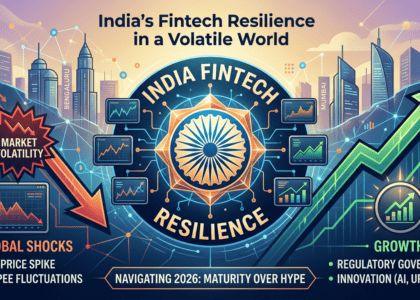
The fintech industry continues its remarkable transformation in 2025, with groundbreaking innovations and regulatory developments reshaping how we interact with financial services. From artificial intelligence revolutionizing fraud detection to India’s UPI system becoming the world’s largest real-time payment network, the financial technology landscape is witnessing unprecedented evolution. Global fintech funding has normalized to $34 billion in 2024, down from pandemic highs but reflecting a more sustainable growth trajectory focused on profitability and real-world applications.

Diagram showing key technologies making up FinTech Intelligence, including AI, Blockchain, Machine Learning, and Finance
AI-Powered Transformation: The New Financial Intelligence
Machine Learning Revolution in Risk Assessment
Artificial intelligence has emerged as the cornerstone of modern fintech operations, with 75% of financial organizations now utilizing AI, up dramatically from 58% in 2022. Leading fintech companies are leveraging machine learning algorithms to revolutionize credit scoring, moving beyond traditional FICO scores to analyze alternative data sources including social media activity, transaction patterns, and utility payments.
Companies like Lendbuzz are using advanced AI to analyze risk and provide credit opportunities to the 45 million U.S. residents categorized as “credit invisible”. Similarly, Upstart’s AI-driven lending platform has demonstrated the ability to identify creditworthy borrowers who might otherwise be overlooked by traditional systems, leading to higher approval rates and lower interest rates.

Anti-fraud benefits of AI for FinTech companies include real-time fraud detection, suspicious behavior prediction, dynamic dataset leverage, and compliance enhancement
Real-Time Fraud Detection and Prevention
The cybersecurity landscape in fintech has been revolutionized by AI-powered fraud detection systems. Mastercard’s Decision Intelligence Pro uses generative AI to scan 1 trillion data points to predict whether a transaction is genuine in less than 50 milliseconds, boosting fraud protection rates by an average of 20%. With cybercrime expected to grow to $10 trillion annually in 2025, these AI-driven defense mechanisms have become critical for financial institutions.
Behavioral biometrics are emerging as a key innovation, with systems that continuously monitor unique user interactions such as typing speed, mouse movements, and device orientation to detect suspicious activity in real-time. This represents a significant evolution from static biometric systems to dynamic, AI-powered authentication methods.
Digital Payments Revolution: India Leads Global Innovation
UPI’s Unprecedented Growth and Global Expansion
India’s Unified Payments Interface has achieved a historic milestone, processing over 18 billion transactions monthly and surpassing Visa to become the world’s top real-time payment system. UPI now handles more than 640 million transactions daily, compared to Visa’s 639 million, representing an extraordinary achievement accomplished in just nine years.
The system processed ₹23.49 lakh crores across 16.58 billion financial transactions in October 2024 alone, marking a 45% year-on-year growth. This success has positioned India as a global leader in faster payments, with UPI now operational in seven countries including the UAE, Singapore, Bhutan, Nepal, Sri Lanka, France, and Mauritius.

Digital payment apps Paytm, Google Pay, and PhonePe use UPI technology for seamless mobile transactions in India
Cross-Border Payment Innovation
The expansion of real-time payment systems is reshaping global remittance markets. The UPI-PayNow linkage between India and Singapore has been expanded to include 19 Indian banks, facilitating seamless cross-border transfers using mobile numbers or Virtual Payment Addresses. Post offices across India are also adopting digital payments, with the rollout of QR-code enabled transactions expected to complete by August 2025.
Blockchain and Cryptocurrency: Market Maturation and Institutional Adoption
Record-Breaking Market Valuations
The cryptocurrency sector reached a significant milestone in 2025, with the total market capitalization exceeding $4 trillion. Bitcoin has demonstrated remarkable strength, surpassing $122,000 in July 2025, with analysts projecting potential targets of $200,000-$250,000 by year-end. This growth has been driven by unprecedented institutional demand through Bitcoin ETFs, with BlackRock’s IBIT now holding 625,000 BTC.

Digital graph showcasing Bitcoin cryptocurrency trends within a fintech context
Blockchain Integration in Traditional Finance
Financial institutions are increasingly recognizing blockchain’s practical applications beyond cryptocurrency. Implementing blockchain in financial services could reduce banks’ infrastructure costs by 30%, potentially saving more than $10 billion annually. The technology is being adopted for secure payments, smart contracts, supply chain finance, and regulatory compliance applications.
Decentralized Finance (DeFi) continues to mature, with the DeFi market valued at $13.61 billion in 2022 and expected to grow at a 46% CAGR. Traditional financial institutions are exploring DeFi protocols for yield generation, cross-border payments, and automated financial services.
Neobanking Evolution: Digital-First Financial Services
Market Growth and User Adoption
The neobanking sector is experiencing robust growth, with India’s neobanking market projected to reach $20 billion by 2030. These digital-only platforms are successfully targeting tech-savvy millennials and Gen Z consumers who prioritize convenience, transparency, and competitive pricing over traditional branch-based services.

Screens of a Bajaj Finserv digital banking app showing loan details, EMI card, and pre-approved offers in a neobank-style interface
Neobanks are differentiating themselves through platform-centric models focused on community engagement, product horizontalization, and mobile-first approaches that result in significantly lower customer acquisition costs compared to traditional banks. Companies like Revolut, Monzo, and India’s emerging players are creating comprehensive financial ecosystems that extend beyond basic banking to include investment services, cryptocurrency trading, and business financial management.
Convergence with Investment Platforms
A notable trend in 2025 is the convergence between neobanks and investment platforms. 60% of millennials and 57% of Generation Z primarily use mobile banking apps, while platforms are expanding their service offerings to capture market share across the entire financial services spectrum.

Dark-themed digital banking app interface showing cards, transactions, and monthly financial overview with categories
Regulatory Renaissance: Balancing Innovation and Consumer Protection
India’s Comprehensive Regulatory Framework
The Reserve Bank of India has established a structured regulatory framework for the country’s 3,000+ recognized fintech startups operating in an industry projected to reach $150 billion by 2025. The Digital Lending Directions 2025 have introduced formal parameters governing relationships between regulated entities and Lending Service Providers, including caps on Default Loss Guarantee cover at 5% of outstanding loan portfolios.
The Payments Vision 2025 framework operates on four foundational pillars: integrity, inclusion, innovation, and institutionalization, with specific targets to triple digital payments from 8,840 crore transactions in FY 2021-22 to 26,520 crore by FY 2024-25.
Global Regulatory Developments
Regulatory clarity is emerging across major markets, with the UAE Securities and Commodities Authority introducing comprehensive frameworks governing “finfluencers” and the Financial Services Regulatory Authority of Abu Dhabi implementing amendments to virtual asset regimes. These developments are creating more favorable conditions for fintech innovation while ensuring consumer protection.
Embedded Finance and Open Banking
Seamless Financial Integration
Embedded finance continues to transform how consumers access financial services, with integration into non-financial platforms becoming increasingly sophisticated. Super apps like Paytm, PhonePe, Grab, and Shopee are evolving into comprehensive financial hubs offering payments, insurance, loans, and investment services within single applications.

A comprehensive overview of the fintech ecosystem showing key companies across various sectors such as digital banking, payments, blockchain, regtech, insurtech, and alternative finance
The Account Aggregator framework in India has expanded to include 12 licensed Account Aggregators serving over 100 million active user accounts, creating an integrated data-sharing network connecting 26 Financial Information Providers and 36 Financial Information Users.
API-Driven Innovation
Open banking initiatives are driving API-first architectures that enable financial institutions to offer modular, customizable services. This shift toward composable finance allows businesses to integrate specific financial capabilities into their platforms without building comprehensive banking infrastructure.
Future Outlook: Sustainable Growth and Innovation
Market Projections and Investment Trends
The global fintech market is projected to grow from $280 billion in 2025 to $1,382 billion by 2034, representing substantial opportunities for continued innovation. Despite funding normalization, the sector maintains strong fundamentals with customer growth at 37% and revenue growth at 40%.

Key components and stakeholders in a startup innovation ecosystem that drive fintech and other technology ventures
Fintech companies are demonstrating improved financial performance while expanding access to underserved populations. 83% of fintechs report improved customer experience from AI adoption, with approximately three-quarters noting higher profitability and reduced costs.
Emerging Technologies and Convergence
The convergence of AI, blockchain, and traditional finance is creating new possibilities for financial service delivery. Real-time payments systems are becoming mainstream globally, demanding sophisticated infrastructure for liquidity management and fraud detection. Green fintech and sustainable banking are also emerging as key differentiators, with financial institutions integrating ESG considerations into their service offerings.
Conclusion
The fintech landscape in 2025 represents a mature yet rapidly evolving ecosystem where technological innovation meets practical financial solutions. From India’s UPI system setting global standards for real-time payments to AI-powered fraud detection protecting billions of transactions, the industry continues to democratize financial access while enhancing security and efficiency.
As regulatory frameworks evolve to support innovation while protecting consumers, and as traditional financial institutions increasingly collaborate with fintech disruptors, the industry is well-positioned for sustainable growth. The convergence of mobile technology, artificial intelligence, and blockchain continues to create new opportunities for financial inclusion, with neobanks and embedded finance solutions reaching previously underserved populations.
The success stories emerging from this dynamic sector demonstrate that the future of finance will be increasingly digital, personalized, and accessible, driven by technologies that prioritize user experience while maintaining the highest standards of security and regulatory compliance.