The Odia music industry has been evolving quietly over the past few years. Instead of loud commercial beats, a new generation of artists has started creating songs built on feeling rather than formula. One of the freshest examples of this shift is “Durataa” — a deeply emotional track by Biraj Rath, Binay Rath & Anurag Sahu, produced by Abinash Panda and released under ABC Studioz in January 2026. But what makes this song special isn’t just the composition. It’s the way listeners adopted it as their own memory.
When we released Durataa, our intention was simple — create an honest emotional story. What followed was something far more interesting than just view counts.
The song didn’t grow like a typical release.
It behaved like a memory being passed from one person to another.
This article is not a promotion — it is our observation of how listeners interacted with the song across platforms and why it resonated beyond expectation.
The Theme — Love That Doesn’t End, It Settles
Unlike typical romantic songs that talk about meeting or separation dramatically, Durataa talks about something more realistic — distance that remains emotionally close.
The song explores:
- unfinished conversations
- memories that refuse to fade
- relationships that continue silently
In simple terms, it is not about heartbreak. It is about after heartbreak — when feelings become habit. Even promotional descriptions describe it as a story of emotions that “stay behind… love that settles into silence.”
This is exactly why listeners connected so quickly. Because most people don’t experience cinematic love. They experience quiet attachment.
Music Style — Minimalism Over Melody Overload
From the beginning, the composition was designed to feel conversational rather than performative.
We intentionally avoided:
- heavy orchestration
- dramatic pitch shifts
- cinematic build-ups
Instead, we focused on emotional neutrality — a feeling that could belong to any relationship stage. After release, audience behaviour confirmed the hypothesis:
People didn’t comment on music production first — they commented on memories.
The majority of engagement revolved around tagging someone, not praising the singer. That is a very different success metric.
The composition relies on softness instead of scale. Rather than heavy percussion, the song uses:
- slow melodic progression
- atmospheric arrangement
- conversational vocals
This creates a “late evening memory” mood — something you don’t actively listen to, but feel while doing something else. That makes it perfect for modern social media storytelling.
Listen on Spotify: https://open.spotify.com/track/4PVq7y…
Listen on Youtube Music : • Durataa
Listen on Jio Saavn : https://www.jiosaavn.com/song/durataa…
Instagram Reels: Where The Song Truly Lived
The real explosion of Durataa didn’t come from YouTube views alone. It came from short-form video culture. Creators started using the track for:
- long-distance relationship reels
- “POV memories”
- goodbye videos
- nostalgic college edits
- slow travel reels
- late night aesthetic videos
We encouraged listeners to create reels — inviting people to “make reels on Instagram and YouTube.” Once users began attaching personal memories to it, the algorithm amplified it naturally. That’s how modern hits are created — not by promotion, but by relatability.
Why It Became Viral ?
Not every emotional song trends. But Durataa had the perfect ingredients:
1. Emotional ambiguity: It isn’t sad, happy, or romantic — it fits any memory.
2. Loop-friendly hook: Works perfectly in 10–20 second edits.
3. Conversational lyrics: Feels like someone speaking to you, not performing.
4. Regional authenticity: Listeners are increasingly supporting original Odia content online — creating stronger engagement communities.
Audience Reaction
Across comment sections and social platforms, a common pattern emerged: People didn’t describe the song technically. They described their memories.
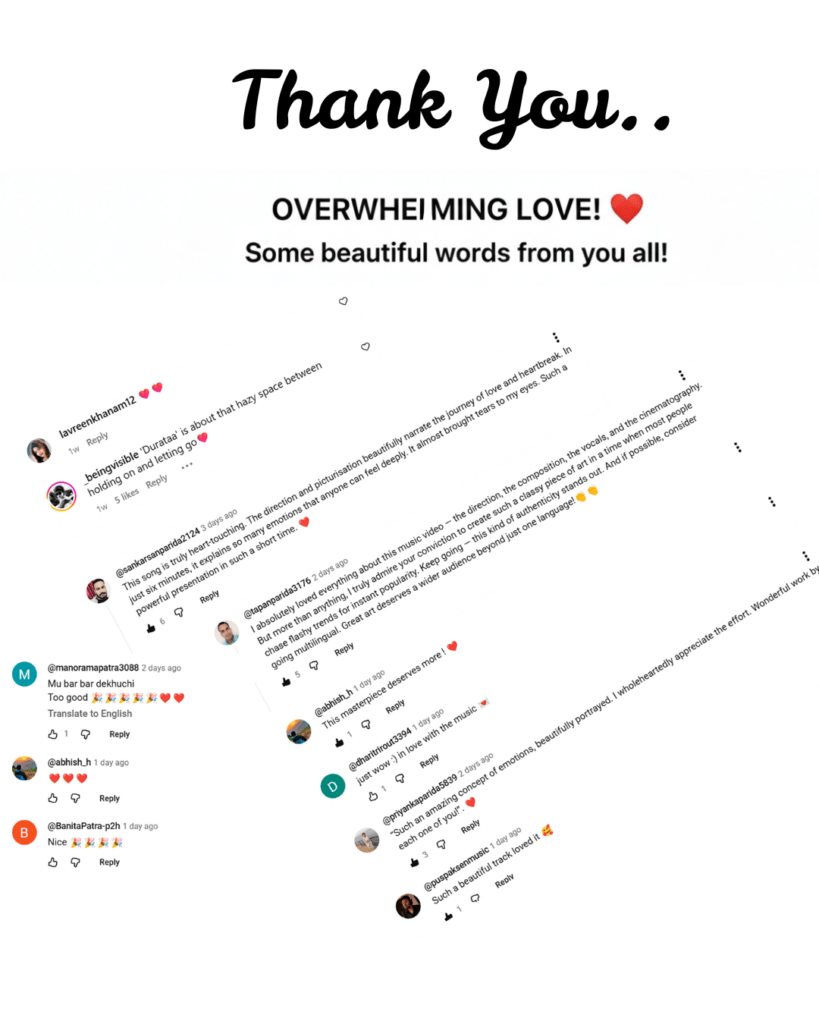
Typical reactions included:
- using it for farewell posts
- remembering someone they stopped talking to
- thinking of college days
- tagging a friend who moved away
Listeners were using the comment section a
That means the song became a medium, not just media. This is the strongest indicator of emotional success.
A viral song is shared.
An emotional song is dedicated.
Durataa became a dedication track.
People were not consuming the song for entertainment. They were storing it for emotional recall. That creates long-tail engagement rather than short spikes.
Cultural Impact — A Shift In Odia Music Consumption
The song also highlights a larger change:
Earlier:
Film songs dominated popularity.
Now:
Independent regional songs grow through social media emotion communities.
Durataa shows that an Odia indie track can:
- travel beyond Odisha
- be used by non-Odia creators
- gain reach without cinema backing
This behaviour signals a structural shift in audience psychology:
- Listeners want songs that feel like conversations
- Relatability beats technical brilliance
- Social storytelling platforms now decide music longevity
- Language is no longer a barrier when emotion is clear
Independent regional music no longer needs cinematic backing to travel across geography. This is the new pathway of regional music success.
What Durataa Thought Us?
From a production perspective, Durataa validated something important for us:
A song becomes successful not when people hear it — but when they use it to say something they cannot say themselves.
The audience didn’t make it popular. They made it personal. And that distinction defines modern music success. Durataa isn’t just a romantic song. It represents a modern feeling — when relationships don’t officially end, but quietly become memories. The audience didn’t make it viral because of beats. They made it viral because they saw their life inside it. And that is the rarest achievement for any song:
People don’t just listen to it — they live through it.