India’s fintech story is no longer a story about whether people will adopt digital payments. That question has already been answered. Over the last decade, India has built one of the world’s most extensive digital financial ecosystems. The Unified Payments Interface, Aadhaar, digital KYC, mobile banking, banking APIs and expanding internet access have fundamentally changed the way money moves across the country.
The scale of this transformation is difficult to ignore. UPI processed 24,161.69 crore transactions during FY2025–26, representing a transaction value of ₹314.23 lakh crore. By June 2026, approximately 55.49 crore users had been onboarded onto UPI. The platform had grown from just 21 banks at launch in 2016 to more than 700 participating banks, while UPI accounted for approximately 85% of India’s digital payment volume in FY2025–26. (Press Information Bureau)
Even more significant is the infrastructure that has emerged around this ecosystem. Payments now connect with banking. Banking connects with commerce. Commerce connects with logistics, payroll, marketplaces and business software. Financial services are increasingly becoming embedded into applications that were traditionally not financial products at all.
The next chapter of fintech, therefore, is unlikely to be defined simply by another payment application. It will be defined by financial infrastructure. It will be about making it possible for a business to collect money, make payouts, manage merchants, reconcile transactions, connect with banks, onboard customers, distribute financial products and access financial intelligence through a connected technology ecosystem.
This is the opportunity that PractoMind is building towards.
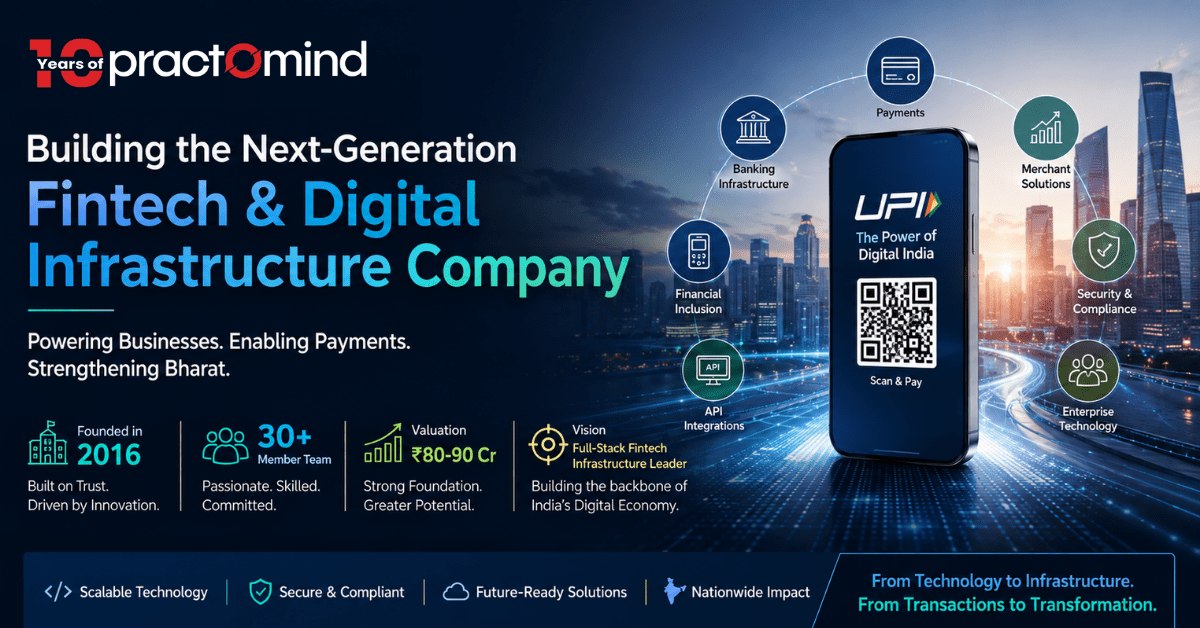
Founded in 2016, PractoMind has evolved into a technology-driven fintech organisation with capabilities across payment technology, banking integrations, transaction services, merchant solutions, financial inclusion, API-led financial infrastructure and digital financial services. With a 30+ member team and an indicative business valuation of ₹80–90 crore, the company is now focused on deepening its fintech identity and developing a broader full-stack fintech ecosystem for the Indian market. The ambition is not to build one more isolated financial product. It is to connect the different layers that make modern financial services work.
The Fintech Opportunity Has Moved Beyond Payments
For years, the most visible part of India’s fintech revolution has been payments. A customer scans a QR code, enters an amount and completes a UPI transaction in seconds. From the customer’s perspective, the process appears almost effortless. But behind those few seconds sits a highly complex financial ecosystem. There is identity and authentication. There is banking infrastructure. There is payment routing. There are transaction records. There are settlement processes. There is reconciliation. There are risk controls. There are merchant systems. There are regulatory requirements. There are customer notifications and dispute mechanisms.
The customer sees a payment.
The financial ecosystem sees an entire transaction lifecycle.
And as digital transactions continue to grow, the infrastructure supporting that lifecycle becomes increasingly valuable.
NPCI’s May 2026 statistics illustrate the scale already being handled by India’s payment infrastructure. UPI recorded more than 23.2 billion transactions in a single month, with 720 banks live on the network. (NPCI)
The implication is important.
The opportunity is no longer simply to build a better way to make a payment.
The opportunity is to build the technology that enables businesses and institutions to operate financially in a digital environment.
That is a much larger market.
What Does a Full-Stack Fintech Ecosystem Actually Mean?
The term “full-stack fintech” can easily become a technology buzzword. For PractoMind, however, the concept is much more practical. A full-stack fintech ecosystem means bringing together the different financial capabilities that a business or institution requires to manage the movement and lifecycle of money.
Imagine a marketplace with thousands of sellers. It needs to onboard those sellers, complete KYC, collect payments from customers, maintain transaction records, settle money to sellers, process refunds, make payouts, reconcile transactions and provide financial reporting. None of these functions exists in isolation, they are part of one financial workflow. Similarly, an enterprise may need to collect payments from customers, make payments to vendors, process employee wages, manage multiple bank accounts, reconcile transactions and monitor cash flows.
A rural financial services network may need to provide Aadhaar-enabled transactions, money transfer, cash withdrawal, insurance and other financial services through local merchants.
A fintech company may need banking APIs, payment infrastructure, merchant onboarding, transaction processing and settlement capabilities without building every component itself.
These are very different businesses, but they have one thing in common:
They all require financial infrastructure.
PractoMind’s full-stack vision is built around providing and integrating that infrastructure.
PractoMind: From Fintech Solutions to Fintech Infrastructure
PractoMind’s journey began in 2016, and over the years the organisation has developed technology capabilities across multiple financial use cases. Its fintech activities include areas such as digital payments, AePS, micro-ATM, domestic money transfer, banking and financial API integrations, transaction services, merchant solutions and financial inclusion.
What is changing now is the way these capabilities are being viewed. Instead of treating them as independent products, PractoMind is bringing them together under a broader financial technology architecture.
This distinction is important.
A company providing only a payment solution solves one problem.
A company providing payments, collections, payouts, banking connectivity, merchant infrastructure, reconciliation and financial services can potentially become part of the customer’s broader financial operating environment.
That is the direction in which PractoMind is developing.
The Foundation: Digital Payments
Payments remain the foundation of the PractoMind fintech ecosystem. India’s payment market is already enormous, and its growth has created an ecosystem of businesses that depend on reliable transaction infrastructure. The opportunity for PractoMind is not to replicate UPI itself. UPI is public digital infrastructure operated by NPCI under the regulatory framework governing payment systems.
The opportunity is to build services and business infrastructure around the payment rails.
A business may want to integrate UPI into its application. A marketplace may need to collect money from customers and subsequently distribute funds to sellers. An enterprise may need automated collections. A platform may need to make thousands of payouts every day. These requirements create demand for payment APIs, transaction management, settlement workflows, reporting and reconciliation. This is where payment technology becomes more than a checkout button. It becomes part of the operating infrastructure of a business.
Collections: Turning Payments into Business Infrastructure
For many businesses, receiving money is only the beginning.
Consider a company receiving thousands of payments every day. It needs to know which customer paid, which invoice the payment relates to, whether the transaction was successful, whether it has been settled and whether the amount appearing in the bank account matches its internal records. As businesses grow, manual collection management becomes increasingly difficult. This creates an opportunity for technology platforms that can connect payment acceptance with transaction records, bank accounts, accounting systems and business workflows.
PractoMind’s broader fintech architecture is designed around this principle. A payment should not disappear into a transaction log; It should become part of a structured financial workflow.
Payouts: The Other Side of Digital Money Movement
The financial technology opportunity becomes even larger when we look at payouts. Every growing digital business eventually needs to move money out. Marketplaces pay sellers. Enterprises pay vendors. Platforms pay partners. Businesses pay employees. Fintech companies distribute funds to merchants and customers. This creates demand for secure and scalable payout infrastructure.
A modern payout platform can connect beneficiary management, bank accounts, payment instructions, transaction status, settlement and reconciliation into one process. For PractoMind, payout infrastructure is therefore a natural extension of its payment and banking technology capabilities.
The larger objective is to support both sides of the financial transaction — money coming into a business and money going out of it.
Banking Connectivity: The Layer Behind Fintech
Modern fintech does not necessarily mean becoming a bank. Increasingly, it means connecting technology platforms with regulated banking infrastructure. APIs have made it possible for financial functionality to be integrated directly into business applications. This is creating an entirely new category of financial technology companies that operate between traditional financial institutions and digital businesses.
PractoMind’s role in this environment is to develop and integrate financial APIs that can connect businesses with banking and payment infrastructure. Depending on the use case and regulatory framework, this can include capabilities around account verification, fund transfers, collections, virtual accounts, transaction information and payout services.This API-driven model is central to the future of fintech because businesses increasingly expect financial services to work inside the applications they already use.
Virtual Accounts and Transaction Banking
As transaction volumes increase, businesses need better mechanisms for identifying and managing money. This is particularly important for companies handling large numbers of customer payments. Virtual accounts can provide businesses with structured collection mechanisms that make it easier to associate incoming funds with customers, invoices, merchants, branches or business units. The value is not simply in having another bank account, the value lies in the automation that can happen around it.
Payments can be identified, transactions can be mapped, records can be reconciled and financial information can be made available to the business in near real time. For large businesses, marketplaces and fintech platforms, this can become an important component of financial operations.
Merchant Technology: Where Payments Meet Business
One of the largest opportunities in India’s fintech market lies with merchants. India has millions of businesses operating across organised and unorganised markets. Digital payments have reached an enormous number of these merchants, but payment acceptance is only the beginning of merchant digitisation.
The next stage is about helping merchants manage their financial activities. A merchant increasingly needs to know not only whether a payment was received, but how much was received, when it will settle, what transactions were completed, what refunds were processed and how the overall business is performing.
This creates a much larger merchant technology opportunity.The future merchant ecosystem could bring together payment acceptance, onboarding, KYC, settlement, reconciliation, transaction analytics, business reporting and access to financial services.
PractoMind’s full-stack approach is designed around this broader view of the merchant.
The merchant is not simply a payment endpoint.
The merchant is a financial customer.
The Bharat Opportunity: Financial Inclusion Beyond Digital Payments
India’s fintech opportunity cannot be understood purely through urban consumers and smartphone-based payments. One of the most significant opportunities remains the financial inclusion of India’s semi-urban and rural population. The Reserve Bank of India has continued to identify digital onboarding and financial inclusion as important areas where fintech can expand access to financial services. (Reserve Bank of India)
The challenge in these markets is often different from that in metropolitan India. A customer may have a bank account but limited access to branches. A small merchant may need to provide basic banking services to the local community. A migrant worker may need to send money home. A rural customer may need access to insurance or assisted banking rather than a sophisticated mobile application.
This is where technologies such as AePS, micro-ATMs and domestic money transfer become particularly important.
PractoMind’s experience in these areas gives it an opportunity to participate in the last-mile financial infrastructure market.
AePS, Micro-ATM and Assisted Finance
Financial inclusion is not necessarily about forcing every customer into a smartphone application. In many parts of India, the most effective model is a combination of digital infrastructure and human distribution. A local merchant, banking correspondent or assisted service point can become the interface between the customer and the formal financial system.
Behind that interface can sit a sophisticated digital platform. Transactions can be authenticated, routed, recorded and reconciled through technology while the customer receives the service locally.
PractoMind’s capabilities around AePS and micro-ATM infrastructure fit into this model. The broader opportunity is to build a financial service ecosystem around these points of access. A merchant that begins by providing cash withdrawal services could potentially become a point for money transfer, insurance, digital payments and other financial services. This is where fintech becomes an instrument of financial inclusion rather than simply a digital convenience.
Domestic Money Transfer and the Movement of Money Across India
India’s internal movement of money is another important fintech market. A large workforce moves between states and cities, creating a continuing need to transfer money between locations. Small businesses also regularly move funds between customers, suppliers, employees and partners. Domestic Money Transfer infrastructure helps address these requirements, particularly in markets where customers may rely on assisted financial service points.
For PractoMind, DMT forms part of the broader financial inclusion and transaction infrastructure proposition. The opportunity is not simply to facilitate remittances, it is to connect remittance infrastructure with a wider network of financial services.
The Rise of Embedded Finance
Perhaps one of the most important developments in global fintech is the emergence of embedded finance. Financial services are increasingly moving into non-financial applications.
- An e-commerce company can embed payments.
- A marketplace can embed seller payouts.
- A payroll platform can embed salary payments.
- A logistics company can embed driver payouts.
- A business software platform can embed collections.
- A merchant platform can eventually embed insurance or credit.
The customer does not necessarily think of these as separate financial services. They simply become part of the product experience. This represents a significant opportunity for PractoMind because its fintech proposition is fundamentally API-driven. The company can provide the financial technology layer that enables other businesses to incorporate financial services into their own platforms.
In this model, PractoMind does not always need to own the customer relationship directly. It can power the financial experience behind another company’s product.
The Opportunity in B2B Fintech
Much of the public conversation around fintech focuses on consumers. However, an equally important opportunity exists in business-to-business financial technology. Businesses are constantly moving money. They collect from customers, pay vendors, settle with partners, process salaries, transfer money between accounts and manage receivables. As businesses digitise, these processes increasingly need to become automated. This creates opportunities across collections, payouts, virtual accounts, reconciliation, transaction banking and financial reporting.
PractoMind’s full-stack model is particularly relevant here because B2B financial infrastructure is inherently interconnected. A company does not need only a payment gateway. It needs a financial workflow. That workflow may begin with customer onboarding, continue through payment collection and end with settlement and reconciliation. The more of that journey technology can automate, the more valuable the infrastructure becomes.
Fintech for India’s MSME Economy
India’s enormous MSME ecosystem provides another major market for financial technology. Many small and medium-sized businesses are becoming digitally enabled, but their financial operations can remain fragmented. They may use one system for payments, another for accounting, a bank application for transfers and manual processes for reconciliation.
The result is a fragmented financial operating environment.
This creates an opportunity for fintech platforms that can bring multiple financial functions closer together.
For an SME, the ideal experience could eventually be:
Receive payments → track collections → pay suppliers → pay employees → reconcile transactions → access financial services
through a connected digital environment.
PractoMind’s long-term full-stack fintech vision aligns closely with this requirement.
The Opportunity for Fintech Companies Themselves
PractoMind’s potential market is not limited to merchants and enterprises. Other fintech companies can also become customers of fintech infrastructure providers. A fintech startup may have an excellent customer proposition but lack the resources or infrastructure to build every banking and transaction capability internally.
It may need:
- Banking integrations
- Payment infrastructure
- KYC
- Merchant onboarding
- Payouts
- Transaction management
- Reconciliation
- Reporting
This creates a B2B fintech infrastructure market where PractoMind can act as a technology and integration partner. In effect, the company can become infrastructure for businesses that themselves are building financial products. That creates a potentially powerful position within the fintech value chain.
Insurance and Embedded Financial Services
The financial relationship with a customer does not end when a transaction is completed. Once customers and merchants are digitally connected, other financial services can potentially be distributed through the same ecosystem. Insurance is one such opportunity.
A merchant payment platform, for example, could eventually become a channel for appropriate business protection products. A rural financial service point could distribute suitable insurance products. A business platform could incorporate insurance into its customer workflow. PractoMind’s role in this space is primarily technology and distribution infrastructure, working through appropriate regulated partners and frameworks.
The broader principle is important:
Payments can become the entry point to a much larger financial relationship.
Credit and Financial Access
Credit represents another major opportunity created by digital financial infrastructure. Small businesses often struggle to demonstrate their financial performance through traditional documentation.
Digital transaction history can provide a different picture.
A merchant’s payment volumes, settlement patterns and business activity can create useful information about the underlying business.
This does not mean that every fintech company should become a lender.
The opportunity can instead be to create technology that enables regulated financial institutions to access, analyse and use appropriate transaction information within compliant frameworks. PractoMind can potentially participate in this ecosystem by providing the technology and transaction infrastructure that connects businesses with regulated financial-service providers. This is particularly relevant to the enormous financing requirements of India’s MSME sector.
AI: The Next Intelligence Layer in Fintech
The next evolution of financial technology will not be driven only by transaction infrastructure. It will increasingly be driven by intelligence. Artificial intelligence can potentially transform how fintech platforms identify fraud, monitor transactions, support customers, reconcile accounts, assess risk and automate financial operations. This is particularly important because financial platforms generate enormous volumes of structured transaction data. The ability to turn that data into useful intelligence can create significant operational advantages.
AI can potentially help answer questions such as:
- Is this transaction unusual?
- Is this merchant behaving differently?
- Which transactions require additional review?
- Why does a settlement not reconcile?
- Which customers are likely to need a particular financial service?
- Which operational processes can be automated?
For PractoMind, AI represents an additional intelligence layer that can eventually sit across its payment, merchant, transaction and financial infrastructure.
The Regulatory Dimension of Full-Stack Fintech
Financial technology is fundamentally different from conventional software. When software handles money, trust becomes part of the product. A fintech platform must therefore consider security, privacy, KYC, AML requirements, fraud prevention, transaction monitoring, data governance, auditability and business continuity. This becomes particularly important as PractoMind develops its ambition to build a more comprehensive payment infrastructure business and pursue the appropriate regulatory framework for Payment Aggregator activities.
A Payment Aggregator model requires much more than a payment interface. It requires merchant onboarding, transaction processing, settlement, reconciliation, dispute management, risk controls, security and compliance. PractoMind’s long-term fintech roadmap therefore has two equally important components: building technology and building the operational and compliance infrastructure required to support that technology.
Where a particular financial activity requires regulatory authorisation, the company’s approach needs to operate within the applicable RBI and other regulatory frameworks, either through the relevant licence or through appropriately regulated partners.
Where PractoMind Fits into India’s Fintech Ecosystem
PractoMind’s position is best understood not as a replacement for banks, payment networks or regulated financial institutions, but as a technology layer that can connect different participants within the ecosystem. At one end are banks and regulated financial institutions, at the other are businesses, merchants, fintech platforms and customers.
Between them sits an increasingly important layer of technology. That layer handles APIs, onboarding, transactions, payments, collections, payouts, reconciliation, merchant management and financial-service integration.
This is where PractoMind intends to build. The company’s opportunity is to make the financial ecosystem easier for businesses to access and easier for financial services to become embedded into business workflows.
Building for Both Digital India and Bharat
One of PractoMind’s distinguishing characteristics is that its fintech opportunity does not have to be limited to one type of customer. At one end of the market is a digitally native fintech company building an application for millions of users. At the other is a rural merchant providing assisted financial services to a local community.
Both require technology.
They simply require different interfaces.
This creates a particularly interesting opportunity for PractoMind. Its fintech architecture can serve sophisticated API-driven businesses while its financial inclusion capabilities can support assisted models across smaller towns and rural markets.
India’s financial future will not be purely digital in the narrow sense.
It will be interconnected, assisted, API-driven and increasingly embedded.
From Individual Products to an Integrated Financial Ecosystem
This is ultimately the central idea behind PractoMind’s full-stack fintech strategy. The company is not looking at payments, banking, merchant services, financial inclusion and embedded finance as unrelated businesses.
They are connected.
A merchant can start with payment acceptance.
Payment data can support reconciliation.
Reconciliation can connect with business accounting.
A digitally connected merchant can potentially access insurance or credit through regulated providers.
A rural service point can start with AePS and expand into money transfer and other financial services.
A fintech company can use APIs to connect all of these capabilities into its own customer proposition.
The ecosystem becomes more valuable as more of these components work together.
Since 2016, PractoMind has built its capabilities around the practical application of technology. Its evolution into fintech has been driven by a recognition that India’s financial services market requires technology that is not merely functional but interoperable. The company’s 30+ member team brings together the technology, product, operations and business capabilities required to develop this ecosystem.
The indicative ₹80–90 crore valuation provides context to the organisation’s current scale and maturity, but the more important story is the direction of the business. PractoMind is moving towards a model where its technology capabilities, fintech integrations, transaction infrastructure and financial inclusion solutions operate as parts of a larger platform. The objective is to create reusable infrastructure rather than repeatedly solving the same financial technology problem for individual customers.
The Market Ahead
The Indian fintech opportunity is becoming deeper rather than simply larger.
The first phase was about adoption.
The second phase was about scale.
The next phase will be about financial infrastructure, intelligence and integration.
India has already built the rails.
UPI provides real-time payment infrastructure at extraordinary scale. Banking institutions provide the regulated financial backbone. Aadhaar and KYC infrastructure support identity and onboarding. Digital commerce creates millions of financial interactions every day.
The private-sector opportunity is to build products and platforms on top of these foundations.
That is why the fintech market remains attractive even after the extraordinary growth of UPI.
The existence of a massive payment network does not eliminate opportunity.
It creates opportunity.
Every new merchant, every new digital business, every new marketplace, every new financial service and every new transaction creates demand for infrastructure around the payment itself.
The PractoMind Vision
PractoMind’s long-term vision is to become a full-stack financial technology platform for India — connecting businesses and financial institutions to the infrastructure they need to collect, move, manage and deploy money digitally.
That vision extends from the payment itself to everything around it.
- From customer and merchant onboarding to KYC.
- From UPI and digital collections to payouts.
- From banking APIs to virtual accounts.
- From transactions to settlement.
- From settlement to reconciliation.
- From merchant technology to business financial management.
- From assisted banking to financial inclusion.
- From payments to embedded insurance and credit enablement.
And increasingly, from transaction data to intelligent financial decision-making. The objective is not to build every financial service independently. The objective is to create the technology layer through which those services can work together.
The Future Is Full-Stack
The Indian fintech industry has reached a point where simply digitising another financial process is no longer enough. India has already shown the world that digital financial infrastructure can transform an economy. UPI has made real-time payments part of everyday life. The next transformation will be less visible but potentially just as significant. It will happen behind the transaction. It will happen in merchant systems, banking APIs, reconciliation engines, payout infrastructure, financial service platforms, risk systems, embedded finance applications and rural distribution networks. It will happen wherever businesses need to connect their operations with money.
That is where PractoMind intends to operate.
Not simply at the point where a payment is made, but across the financial ecosystem that makes that payment possible, manageable and valuable.
- From payments to banking.
- From merchants to enterprises.
- From digital transactions to financial inclusion.
- From APIs to embedded finance.
- From individual fintech services to connected financial infrastructure.
PractoMind is building a full-stack fintech ecosystem designed for the next phase of India’s digital financial economy.